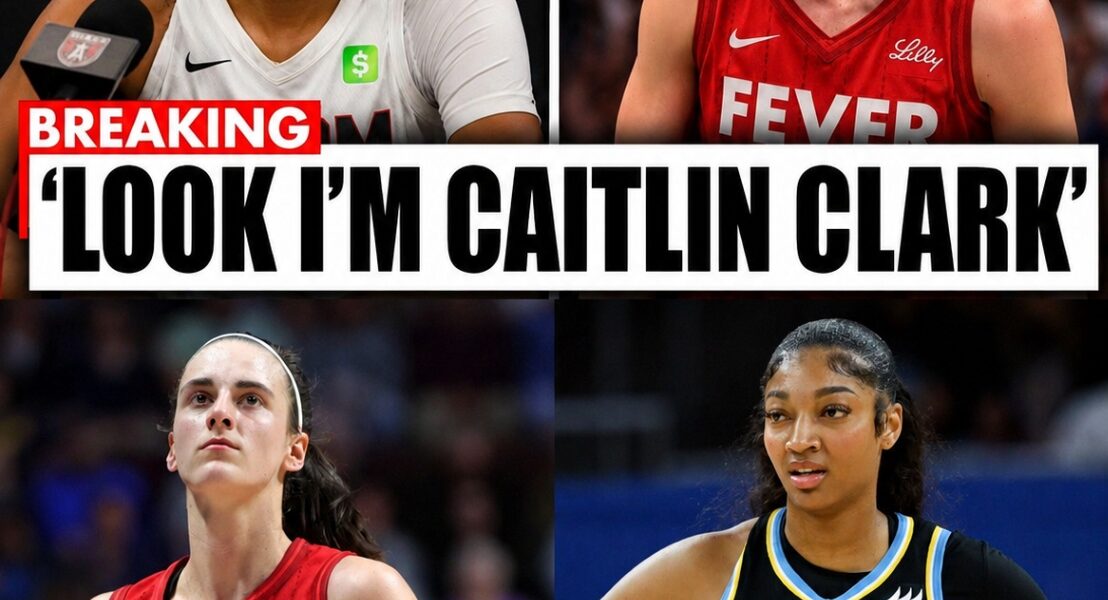

WNBA Debate Explodes After Angel Reese–Caitlin Clark Moment Leaves Fans Divided

The WNBA world is once again locked in a heated debate after a tense on-court moment involving Angel Reese and Caitlin Clark sparked a wave of reaction across social media.
What some fans saw as harmless competitive energy, others viewed as disrespectful taunting.
And once Caitlin Clark’s foul trouble, Indiana’s silence, and Stephanie White’s coaching decisions entered the conversation, the story became much bigger than one moment between two players.
For many viewers, the flashpoint came when Reese appeared to mirror Clark’s movements and gesture in her direction during a tense stretch of the game. The clip quickly began spreading online, with fans arguing over what the moment really meant.
Was it simply rivalry basketball?
Was it psychological warfare?
Or was it another example of Clark being targeted while her team failed to respond strongly enough?

That question is now at the center of the latest WNBA firestorm.
Clark has become one of the most watched players in basketball, and with that attention comes constant scrutiny. Every foul, every reaction, every possession, and every exchange with an opponent is immediately analyzed frame by frame.
Reese, meanwhile, has never been afraid of emotion or confrontation on the court. Her confidence, physicality, and expressive style have made her one of the league’s most talked-about players. Supporters say that intensity is part of what makes her special. Critics argue that certain moments cross the line.
This latest incident has only deepened that divide.
On one side, fans defended Reese, saying competitive gestures have always been part of basketball. In their view, Clark is not being treated differently from any other star player, and emotional games naturally produce emotional moments.
On the other side, Clark supporters argued that the Fever guard appeared isolated during a difficult stretch. They pointed to her early foul trouble, the pressure she faced defensively, and what they viewed as a lack of visible protection from Indiana’s bench.
That is where head coach Stephanie White became part of the debate.
Some fans questioned whether White did enough to control the situation and protect her franchise player. Others focused on challenge decisions, arguing that Indiana failed to use critical moments wisely while Clark was struggling to stay on the floor.
To those critics, the issue was not only Reese’s behavior.
It was Indiana’s response.
They saw a star player under pressure, a bench that looked too quiet, and a team that seemed unable to shift the emotional tone of the game.
For a franchise built around Clark’s arrival and the massive attention she brings, that perception matters.
This was not just another regular-season debate. It touched something deeper: whether the Fever have the culture, toughness, and leadership needed to support a generational player through the chaos of the WNBA spotlight.

Clark’s talent is not in question. Her ability to change the pace of a game, stretch defenses, create offense, and bring new eyes to the league has already been proven. But as her profile grows, so does the physical and psychological pressure around her.
The WNBA is not a friendly adjustment period. It is a league full of veterans, rivals, strong personalities, and players who have no interest in giving Clark an easy path.
That is why moments like this matter so much to fans.
They are not only watching Clark’s numbers. They are watching how Indiana responds when opponents try to get under her skin. They are watching whether teammates step in emotionally. They are watching whether the coaching staff controls the game before it slips away.
And in this case, many fans believe Indiana failed that test.
Still, there is another side to the story.
Basketball has always included trash talk, gestures, mind games, and emotional battles. Great rivalries are often built on tension. Reese and Clark have been linked since their college days, and every meeting between them carries extra attention because fans already expect drama.
That attention can sometimes turn normal competitive moments into viral controversies.
A gesture becomes a national debate.

A coaching decision becomes a cultural argument.
A loss becomes a referendum on an entire organization.
That is exactly what happened here.
The scoreboard may have told one story, but the reaction afterward told another. For Clark supporters, this felt like a warning sign. For Reese supporters, it was just another example of a confident player refusing to back down. For neutral fans, it was proof that the WNBA has entered an era where every rivalry moment can dominate the sports conversation.
The biggest question now is not whether Angel Reese went too far or whether Caitlin Clark was treated unfairly.
The bigger question is what Indiana does next.
Does the Fever locker room respond with more edge?
Does Stephanie White adjust how she manages pressure situations?
Does Clark continue to absorb the spotlight alone, or does Indiana begin to show a stronger collective identity around her?
Those answers will matter far beyond one game.
Because in a league where attention is growing and every matchup feels bigger than before, the Fever cannot afford to look passive when their biggest star is at the center of the storm.
One thing is certain: this debate is not going away.
Angel Reese and Caitlin Clark remain two of the most polarizing young stars in basketball. Every meeting between them will bring emotion, pressure, and viral moments.
But this latest controversy has left fans asking one uncomfortable question:
Was this just another intense night in the WNBA — or did it reveal deeper cracks inside the Indiana Fever?